What Is a Kitchen Faucet Deck Plate?
A kitchen faucet deck plate covers unused mounting holes around a faucet and can help a single-hole faucet fit a multi-hole sink. Measure the hole spacing and check the faucet’s mounting instructions before choosing a plate.
On this page (8 sections)
- What does a kitchen faucet deck plate cover?
- How do you measure for a kitchen faucet deck plate?
- Does every faucet need a deck plate?
- Which separate deck plate fits your faucet?
- How do finish and material affect your choice?
- How do you install a faucet deck plate?
- What mistakes should you avoid when choosing a deck plate?
- How should you choose a kitchen faucet deck plate?
A kitchen faucet deck plate covers unused mounting holes around a faucet and can help a single-hole faucet fit a sink with multiple holes. The right plate must span the openings, fit the faucet’s mounting layout, and rest flat on the sink or counter.
Also called an escutcheon or faucet base plate, it leaves a tidier surface when an old faucet used more holes than its replacement. A plate cannot fix every mismatch, so measure before you buy.
What does a kitchen faucet deck plate cover?
A kitchen faucet deck plate covers unused mounting holes around the faucet. The faucet passes through the plate’s center opening, while the plate rests on the sink or counter.
A common setup has a single-hole faucet mounted in the center of a three-hole sink. The plate spans the two outer holes and covers them.
Some plates are made for a particular faucet family, while others suit a broader range of layouts.
A plate’s overall length is only part of the fit. The center opening, the spacing between sink holes, and the surface around them all matter.
How do you measure for a kitchen faucet deck plate?
Measure the sink holes and compare the usable coverage with the plate’s dimensions. Also check that the faucet can pass through the opening and be secured with its mounting hardware.
Measure from the center of one outer hole to the center of the other. Then check the plate’s length and shape to make sure it covers both openings with room to sit flat.
Look for raised edges, ridges, or curves that could prevent it from resting evenly.
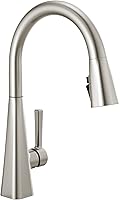
The Moen Adler Pulldown (87233SRS) includes a deck plate and is described for 1- or 3-hole installations. It’s a practical option if you’re replacing the faucet too and want the cover included.
A deck plate won’t make every faucet fit every sink. If your replacement faucet has a single-hole mount, check the details in our guide to single-hole kitchen faucet fit.
Does every faucet need a deck plate?
No. A deck plate is useful when it covers unused holes or when the faucet’s design calls for one, but many installations don’t need a separate plate.
A single-hole sink paired with a faucet designed for a single-hole mount may need no cover. On a three-hole faucet, the side openings may hold separate handles, leaving no unused holes for a wide plate to cover.
Check whether the faucet’s plate is included, optional, or required. If you’re replacing an old fixture, our kitchen faucet installation guide explains how to check the sink and prepare the mounting area.
Which separate deck plate fits your faucet?
Choose a separate plate by matching faucet compatibility, hole spacing, dimensions, and finish. A plate that covers the holes but conflicts with the faucet base or sink shape can still be the wrong choice.
The Kraus Deck Plate (Spot Free Stainless) measures 10 1/4 inches long, 2 1/2 inches wide, and 1/4 inch high. Kraus describes it as compatible with its single-hole kitchen faucets, so it suits buyers who have a matching Kraus faucet and need to cover extra holes.
Skip this option if you have a different faucet brand and haven’t confirmed that the opening and mounting layout match. Its metal construction and corrosion-resistant finish make it a straightforward choice for someone who wants a rectangular cover in Spot Free Stainless.
The 10-Inch Stainless Deck Plate measures 10 inches long and 2.3 inches wide. It’s described for covering the outer holes when a single-hole faucet is installed on a 2- or 3-hole sink, but the measurements still need to suit your sink.
This plate may suit a compact sink or a small kitchen where its size matches the hole spacing.
Skip it if the outer holes fall beyond its coverage or you need a different finish. Its foam pad is designed to help keep the plate from sliding, and the care instruction is simple: wipe it with a dry cloth.
How do finish and material affect your choice?
Match the finish to the faucet if you want the plate to blend in, and consider the plate’s material and care needs. A finish that contrasts with the faucet can stand out even when the fit is right.
The Kraus plate comes in Spot Free Stainless and has an all-metal construction. The 10-Inch Stainless Deck Plate is 304 stainless steel with a brushed nickel finish.
The Moen Adler has a Spot Resist Stainless finish, which Moen says resists fingerprints and water spots.
A finish name alone doesn’t ensure two parts will look identical. If appearance matters, compare the plate and faucet in person when possible, and check that the plate can sit flat on your sink.
How do you install a faucet deck plate?
Install the plate as part of the faucet mounting process, following the faucet’s instructions. It usually sits between the faucet base and the sink or counter.
- Turn off the water supply and remove the old faucet if needed.
- Clean and dry the mounting area.
- Position the plate over the holes as directed.
- Feed the faucet connections through the plate and sink opening.
- Secure the faucet from below, then reconnect the water supply.
- Turn the water on and check beneath the sink for drips.
Some plates include a gasket or pad, while others use parts supplied with the faucet. Follow the specified parts and sealing method instead of assuming the plate itself makes a watertight seal.
If the faucet shifts after installation, check the mounting hardware beneath the sink. Our guide to tightening a loose kitchen faucet covers common checks around the mounting area.
What mistakes should you avoid when choosing a deck plate?
The most common mistake is buying by appearance or overall length alone. Check the hole spacing, opening, plate width, sink shape, and faucet instructions before ordering.
Don’t assume every plate fits every faucet, even if both use a single-hole layout. The Kraus plate is described for Kraus single-hole faucets, while other faucets may have different base or mounting dimensions.
Don’t rely on a deck plate to cover holes that are too far apart. A plate also won’t solve a mismatch in mounting hardware or make a faucet’s connections fit through an unsuitable opening.
After installation, keep the plate and surrounding sink area dry when practical, and wipe away water marks or residue. For a plate with foam underneath, avoid pulling it across the sink because the pad is meant to help hold its position.
How should you choose a kitchen faucet deck plate?
Choose the Moen Adler if you’re buying a faucet as well as a cover and want a model described for 1- or 3-hole installations. Choose the Kraus plate if you have a compatible Kraus single-hole faucet and want its specified rectangular cover.
Choose the 10-Inch Stainless Deck Plate when its dimensions and opening suit your sink, including a compact setup where the outer holes are close enough. Skip any separate plate if your faucet uses all the sink holes or if you can’t confirm the fit.
Measure first, compare the faucet instructions, then choose the plate that covers the openings and rests flat. For more on spout and mounting styles, see our guide to kitchen sink faucets.
Frequently asked questions
What does a kitchen faucet deck plate do?
A kitchen faucet deck plate covers unused mounting holes around a faucet. It can also give the faucet a wider base, depending on its design.
Check that the plate is long enough to span the holes and that its opening and mounting layout match your faucet.
Do all kitchen faucets come with a deck plate?
No. Some faucets include a deck plate, while others are sold without one.
Check the faucet’s installation instructions to see which parts are included and whether the plate is optional or required.
If you need a separate plate, compare its dimensions and finish with the faucet and sink.
Can I use a deck plate on a three-hole sink?
Often, yes. A deck plate can cover the outer holes when a single-hole faucet sits in the center, if the plate spans the holes and fits the faucet base.
Measure between the outer holes and compare that distance with the plate’s usable coverage.
Does a deck plate prevent leaks?
A deck plate mainly covers unused mounting holes and gives the faucet a finished base. It does not replace the faucet’s gasket or the sealing method in its instructions.
After installation, turn the water on and check beneath the sink for leaks.